

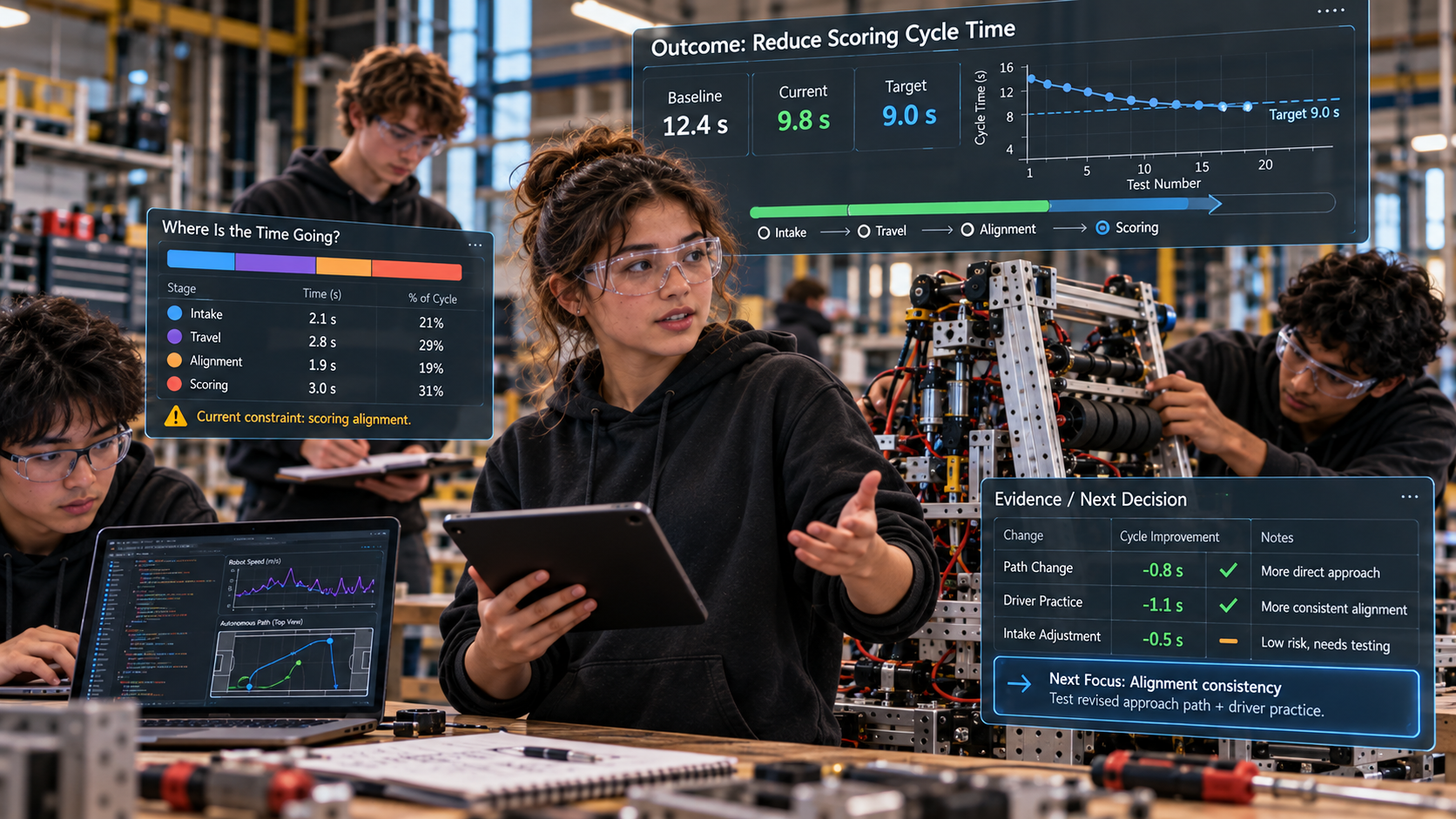
Imagine an FRC team that decides its scoring cycle is too slow. Mechanical starts looking at the intake and programming works on faster paths and better alignment. The drive team adds more practice and strategy studies where time is being lost during matches. Everyone is doing useful work, and each group may make its part of the robot better. A week later, the robot has improved in several ways, but the larger question is sometimes difficult to answer: did we actually make the scoring cycle meaningfully faster?
The mechanical lead can explain what changed on the intake. Programming can show the new path. The drive team can talk about practice. Strategy has more data. A captain (officer or a lead) may be checking on all of them and trying to keep the pieces connected. Everyone owns a piece, but it is not always clear who owns the result.
That problem exists with or without AI. A team could organize around outcomes, give students meaningful authority, and develop this kind of leadership without using a single generative AI tool. In many ways, these are simply good engineering and organizational practices. So why does this belong in a series about AI-native FRC teams?
Because AI makes the shift both more practical and more important. As students gain the ability to understand unfamiliar areas, cross traditional sub-team boundaries, prototype ideas faster, and accomplish more with smaller groups, implementation becomes less likely to be the constraint. The harder problem increasingly becomes deciding what matters, bringing the right expertise together, making tradeoffs, evaluating results, and driving a problem all the way to an outcome.
Some of the most important adaptations to AI are not AI techniques at all. They are practices that were already valuable, but become much more important when the capabilities of each student expand. One of those practices is giving students real ownership of problems.
Component Ownership Is Not Outcome Ownership
FRC teams are usually good at assigning responsibilities. Someone owns the elevator. Someone is responsible for vision. A student leads electrical. Another student manages scouting. Programming may have an autonomous lead, while mechanical divides the robot into mechanisms. That structure is useful because components need owners. If nobody is responsible for the intake, there is a good chance the intake will not get finished.
But many of the outcomes that matter most on a robot do not belong to one component. Cycle time is not a drivetrain problem. Autonomous reliability is not only a programming problem. Intake consistency is not only a mechanical problem. Match readiness is not owned by electrical, strategy, or the drive team alone. Each of those outcomes depends on several parts of the system working together.
That creates an organizational gap. A team can assign every component clearly and still leave the most important result without a clear owner. Component ownership asks who is responsible for this part. Outcome ownership asks who is responsible for making this result happen. A strong FRC team needs both.
Article 2 explored the idea that sub-teams should be capability structures rather than permission structures. Students still need places to develop deep expertise, but important problems should be able to cross those boundaries. Once the work begins crossing those boundaries, someone has to connect it.
Who owns the problem from beginning to end?
Give One Student the Problem, Not All the Work
Suppose the team decides that reducing scoring cycle time is important enough to deserve focused attention. One student could own that outcome. Their job would not be to redesign the intake, rewrite the path planner, coach the drivers, and perform the strategy analysis personally. That would defeat the purpose.
Their job would be to understand the problem well enough to bring together the right people, identify where time is actually being lost, decide what to investigate, coordinate experiments, respond to evidence, and keep the team focused on whether the robot is getting faster. Mechanical expertise still comes from mechanical students. Programming expertise still comes from programmers. Strategy still brings match understanding. The drive team still brings experience that no simulation fully captures. The outcome owner connects those contributions.
Owning the problem does not mean doing all the work. It means making sure the work adds up to the outcome.
Some organizations use the term Directly Responsible Individual, or DRI, for this role. I will use that term as shorthand, but the label matters less than the idea. For an important outcome, there should be a student who can clearly say, “I own getting us there.”
That is different from being the person who schedules meetings or asks everyone for status. It is also different from being the most technically experienced person in the group. The DRI owns the problem, not all the expertise required to solve it.
This distinction becomes especially useful in an AI-native environment. AI can help a student understand areas outside their deepest specialty, analyze data, explore alternatives, and communicate more effectively with experts. It can increase the range of a student who owns an outcome without pretending that the student has suddenly become an expert in every discipline involved. The student can reach further without having to do everything themselves.
Leadership Should Not Depend Only on Titles
This model also changes how we think about student leadership. On many teams, the clearest path to leadership is a title. Students become captains, officers, sub-team leads, or technical leads. Those roles are valuable. Teams need people thinking about culture, priorities, technical coherence, safety, and the development of other students.
But titles do not have to be the only way students practice leadership. A second-year programming student might own autonomous reliability. A mechanical student might lead a robot weight reduction effort. A strategy student might own improving how quickly scouting information becomes a match plan. A student who has never been a sub-team lead might own an effort to reduce repair time between matches.
Each of those students would have to make decisions, work across boundaries, ask for help, reconcile competing perspectives, respond when an idea fails, and ultimately take responsibility for a result. Those are leadership experiences, even if the student does not hold a formal team title.
Leadership should be something students practice, not only a title they hold.
Outcome ownership creates more opportunities for students to lead consequential work without requiring the team to create more permanent leadership positions. It also reduces pressure on captains and sub-team leads to become the integration point for every important problem. A captain does not need to personally coordinate every cross-functional effort simply because the work spans multiple groups, and a programming lead does not need to own every problem that happens to involve software. Leadership can move with the work, which gives more students opportunities to develop it.
Responsibility Without Authority Is Not Ownership
There is an easy way to get this model wrong. A team tells a student, “You own autonomous reliability,” but every meaningful decision still has to be approved by the programming lead. Changes involving another sub-team require a captain to negotiate them. A mentor decides which idea should be tried. The student is responsible for tracking the work, but the authority to shape it still lives elsewhere.
That student does not really own the outcome. They are coordinating it.
Real ownership requires enough authority to act. A student DRI should be able to bring together the people needed to investigate the problem, run experiments, make reasonable decisions within agreed constraints, change direction when evidence shows the current approach is wrong, and ask other groups for help. If every consequential choice still flows back to someone else, responsibility has moved but ownership has not.
That does not mean unlimited authority. The appropriate boundaries depend on the student’s experience, the learning objective, the technical risk, safety, team standards, and FIRST rules. A student experimenting with scouting analysis can be given much more freedom than a student proposing a high consequence change to a mechanism shortly before an elimination match.
Mentors and experienced students still matter. Their role is not to disappear from the decision. Their role is to help the student make a better one. A mentor might ask what makes the student think this is the main source of the problem. A technical lead might point out a constraint the student has not considered. An experienced mechanical student might explain why a proposed change introduces another failure mode. Those conversations strengthen the student’s ownership rather than quietly taking it away.
This is part of what it means for mentors to build capability rather than dependency. If every consequential decision eventually flows back to the same mentor, captain, or senior student, the team may have assigned responsibility without actually distributing ownership. Student agency requires both sides to change. Students have to accept more accountability, and the people who already hold authority have to create room for them to exercise it.
AI Can Perform Work. It Cannot Own the Outcome
AI adds another layer to this model. Suppose a student DRI uses AI to analyze telemetry, generate a script, compare path options, summarize match video, or propose changes to a control routine. The AI may perform a meaningful amount of the work, but that does not change who owns the result.
If the generated analysis is wrong, the student cannot simply say that the AI said it was right. If the code behaves badly on the robot, responsibility does not transfer to the coding agent. If an AI-generated design recommendation ignores an important constraint, someone still has to recognize that before the robot pays the price.
AI can perform work. It cannot own the outcome.
That is one reason outcome ownership matters more as AI becomes capable of doing more. If we measure student contribution only by who typed the code, drew the CAD, or produced the analysis, AI makes ownership increasingly difficult to see. But if we look at who defined the problem, exercised judgment, brought together the right expertise, evaluated alternatives, verified the result, and responded when things went wrong, ownership becomes much clearer.
A student can delegate work without delegating accountability. That distinction is central to an AI-native team.
Owning the Outcome Means Owning the Evidence
There is another difference between owning tasks and owning an outcome. Imagine asking the student responsible for cycle time how the effort is going. They might say that mechanical finished the intake changes, programming updated the path, and the drive team practiced for two hours. Those are useful status updates, but they still do not answer the question that matters most: did the robot get faster?
An outcome owner should increasingly be able to answer that with evidence. Perhaps average scoring cycle time improved under realistic practice conditions. Perhaps acquisition is now faster but alignment remains inconsistent. Perhaps the mechanical redesign produced less improvement than expected, while driver practice created a larger gain. Perhaps performance improved on an empty field but degrades significantly when another robot is nearby.
Owning the outcome means understanding not just what the team did, but what happened as a result.
Owning the outcome includes owning the evidence that tells the team whether the outcome is good.
This does not mean every student DRI needs a sophisticated dashboard or a perfect metric before work can begin. Sometimes the team will start with an imperfect definition and improve it as it learns. But there should be some answer to the question, “How will we know whether this actually got better?”
That question changes the conversation. Instead of celebrating that every task on the list is complete, the team can ask whether completing those tasks produced the result it wanted. This distinction will become much more important in the next article.
What Changes for Captains, Leads, and Mentors
Giving students more outcome ownership does not make captains, sub-team leads, or mentors less important. It changes where they create the most value. A captain who no longer has to chase every cross-functional task can spend more time maintaining priorities, resolving conflicts that genuinely require broader context, developing other student leaders, and watching the health of the team as a whole.
A sub-team lead can spend less time protecting work inside a specialty and more time building capability. They can teach standards, make expertise available to outcome owners, review consequential decisions, and help students recognize when they are entering an area where deeper knowledge matters. Mentors can focus more on fundamentals, architecture, safety, experimental design, and judgment. Instead of becoming the person who approves every decision, they can ask the questions that help students make stronger decisions themselves.
This may be uncomfortable. When experienced people see a student heading toward a decision they would not make, the fastest response is often to step in and fix it. Sometimes that is necessary, particularly when safety or high consequence decisions are involved. But if adults or senior students reclaim every difficult decision, students never develop the judgment we ultimately want them to have.
The goal is not less mentorship. It is mentorship that produces more capable owners.
Ownership Should Leave the Team Smarter
There is one more responsibility that comes with owning consequential work. The team should retain what it learned.
Suppose the cycle-time effort discovers that an intake redesign was unnecessary because most of the lost time came from alignment. Or the group learns that a particular path looks faster in simulation but performs worse once driver interaction is considered. Or a sensor that everyone assumed was reliable turns out to behave differently after repeated impacts. Those lessons should not disappear when the students move to the next problem.
A good outcome owner leaves behind more than the result. They leave behind enough context for the next person to understand what was tried, what failed, what constraints mattered, what evidence changed the plan, and how the result was verified. That does not require turning every project into a documentation exercise. The goal is not to create more files that nobody reads. The goal is cumulative learning.
Every significant piece of work should make the next piece of work easier. A failed experiment can still make the team better if the next student does not have to repeat it to learn the same lesson.
This is another place where AI can help. It can reduce the friction of capturing decisions, summarizing experiments, identifying documentation that needs updating, or organizing lessons while the context is still fresh. The judgment still belongs to the students, but AI can help make sure that judgment does not disappear when the meeting ends.
Students own outcomes. Evidence makes that ownership accountable. Shared knowledge makes it durable.
Return to the Cycle-Time Problem
Now return to the original problem. The team wants to score faster. Instead of sending mechanical, programming, strategy, and drive team away to improve their respective pieces and hoping the improvements add up, one student owns the outcome.
The first thing that student does may not be assigning work at all. They may start by measuring where the time is actually going. Perhaps the team assumes the intake is slow because that is the most visible delay, but video and telemetry show something different. Acquisition takes slightly longer than desired, while most of the variation actually comes from alignment at the scoring location.
Mechanical still has ideas for improving the intake. Programming thinks it can change the approach path. Drive team believes practice can reduce hesitation. Strategy points out that some routes create better approach angles than others. The DRI does not need to choose one discipline and declare it the answer. Their job is to keep everyone solving the same problem.
They might run one experiment with a path change, another with driver practice, and another with a small mechanism adjustment. Some ideas work. Others do not. The plan changes as evidence accumulates. At the end of the effort, the student should be able to explain more than what each sub-team completed. They should be able to explain what improved, which ideas mattered, what still limits performance, what the team learned, and why the current result is good enough or not good enough.
That is outcome ownership, and it is a different kind of student leadership.
Start With One Outcome
None of this requires a new org chart. Choose one meaningful problem that already crosses team boundaries. It might be autonomous reliability, scoring cycle time, intake consistency, robot weight, readiness between matches, or the time between collecting scouting data and turning it into a useful match plan.
Choose one student to own the outcome. Be explicit about what they are responsible for and what authority they have. Give them access to the people with the expertise they need. Let mentors and student leads provide context, challenge assumptions, and establish appropriate guardrails without automatically taking over the decisions.
Then watch what happens. Does everyone know who owns the outcome? Can the student bring the right people together? Do decisions move faster or simply move back to the same senior people? Can the student explain whether the work is actually improving the result? What evidence are they using? When something fails, do they take responsibility for learning from it? Does the work leave enough context behind that someone else could continue it later?
One experiment is enough to learn something. As with the shift across sub-team boundaries, there is no need to reorganize the whole team before evidence says the model is useful.
Own the Problem
FRC has always created opportunities for students to lead. Captains lead teams. Sub-team leads develop expertise. Students design mechanisms, write software, build strategy, and represent their teams in consequential moments.
Outcome ownership adds another kind of leadership. It gives a student a meaningful problem and asks them to carry it from ambiguity to evidence. The student does not need to know everything. They need to know when to bring in someone who knows more. They do not need to perform every task. They need to make sure the work adds up to the result. They do not need unlimited authority. They need enough authority to exercise judgment within appropriate boundaries.
AI did not invent this model, but AI makes it more relevant. As implementation becomes easier and students become capable of reaching across more technical boundaries, the value of deciding what matters, integrating expertise, evaluating results, and taking responsibility for an outcome increases.
The question shifts from “Who owns this component?” to “Who owns making this better?” A student who truly owns the problem should eventually be able to say that they know what the team is trying to achieve, who they need, which decisions matter, whether the result is improving, what the team has learned, and what happens next if it does not work.
Once a student owns the problem, the next question becomes unavoidable:
What does good actually look like?