


It all started with a single question: “What is RAG in AI?”
As I dove deeper into Retrieval-Augmented Generation (RAG), I was struck by how this single innovation represents a significant leap in what AI can do. That curiosity led me to a bigger reflection, how have the capabilities of AI evolved over time? Not just how it works under the hood, but what it can actually do, generation by generation.
While there are many ways to look at the evolution of AI: through algorithms, infrastructure, or models, this blog takes a capability-centric view. We’ll explore what AI could do at each stage, how it acquired new skills, and what those advancements enabled in the real world.
Let’s walk through the evolutionary timeline of AI through this lens.
[1950s–1980s] Symbolic AI: The Age of Rules
In the earliest days of artificial intelligence, AI systems were hard-coded with logic and rules. These were known as expert systems or symbolic AI, where every possible scenario had to be anticipated in advance.
What AI could do:
- Make decisions by following if-then rules
- Simulate domain-specific expertise (e.g., medical diagnosis, chess strategies)
Limitations:
- Brittle: could not handle exceptions or ambiguity
- No learning capability, systems had to be manually updated
This was a time when AI could “think” but only within a rigid, pre-defined box.
Technologies: LISP, Prolog, DENDRAL, MYCIN (early expert systems)
[1990s–2010s] Machine Learning & Deep Learning: Learning from Data
The 1990s ushered in a new capability: AI systems that could learn from data. With statistical learning and the eventual deep learning revolution (especially after ImageNet in 2012), AI could now find patterns without human-defined rules.
What AI could do:
- Classify data, detect objects, predict trends
- Learn from examples instead of rules
- Perform well on vision, speech, and tabular data
Limitations:
- Still narrow in scope (trained for one task only)
- No real understanding of meaning or context
- Prone to overfitting, data hunger
This was the era of pattern recognition, powerful, but not truly conversational or flexible.
Technologies: Support Vector Machines (SVMs), Random Forests, Deep Neural Networks (CNNs, RNNs), TensorFlow, PyTorch
[2018–2020] LLMs (BERT, GPT): Understanding and Generating Language
The release of transformer-based models like BERT (2018) and GPT-2/3 (2019–2020) marked the beginning of the language era. For the first time, AI could generate human-like text, answer open-ended questions, and understand meaning across paragraphs.
What AI could do:
- Understand natural language with context
- Generate coherent long-form text
- Perform few-shot learning via prompts
Limitations:
- Static knowledge (frozen after training)
- Hallucinations: AI made up facts with confidence
- No awareness of up-to-date or external info
This was the age where AI started sounding human, but often lacked grounded truth.
Technologies: BERT, RoBERTa (understanding), GPT-2/3, T5 (generation), Hugging Face Transformers
[2020–2024] RAG: Retrieval Meets Generation
Retrieval-Augmented Generation (RAG) brought a new capability: accessing external knowledge in real-time. Instead of relying solely on internal memory, LLMs could now retrieve relevant documents and generate responses based on that context.
What AI could do:
- Answer questions using up-to-date external sources
- Reduce hallucinations by grounding answers
- Combine search + language generation in one pipeline
Limitations:
- Dependent on retrieval quality
- Complex infrastructure
- Still lacks reasoning or task execution
RAG is like giving AI a library card, it now reads before it writes.
Technologies: FAISS, Pinecone (vector DBs), LangChain, Haystack (orchestration frameworks), Dense Passage Retrieval (DPR), OpenAI Embeddings
[2023 onwards] AI Agents: From Answers to Actions
The next capability leap came with AI Agents: systems that don’t just talk but act. These agents can call tools, run functions, and plan multistep tasks. Now, AI isn’t just generating, it’s doing.
What AI could do:
- Use tools like calculators, APIs, and web browsers
- Chain tasks together with planning
- Automate workflows or assist in coding, scheduling, etc.
Limitations:
- Still experimental and unpredictable
- Requires secure APIs and trusted tools
- Risk of missteps or over-automation
This is where AI becomes more than an assistant, it’s becoming a co-worker.
Technologies: OpenAI Functions, LangGraph, AutoGPT, Agent-LLM, Toolformer, ReAct pattern
[2024 onwards] Trust & Governance: Making AI Accountable
As AI systems become more autonomous, we need trust, transparency, and control. This era is about embedding zero-trust principles, provenance, and access control in AI systems.
What AI could do:
- Log and explain tool use
- Authenticate actions and users
- Apply access restrictions and auditing
Limitations:
- Standards still evolving
- Adds friction to experimentation
- Requires infrastructure maturity
Now we ask not just what AI did, but how, why, and can we trust it?
Technologies: Model Context Protocol (MCP), Provenance tracking, Fine-Grained RBAC, Zero-Trust Architecture (ZTA) for agents
[Future] Modular AI Ecosystems: The Rise of Multi-Agent Intelligence
The future belongs to ecosystems of smaller, specialized AIs that collaborate, share memory, and coordinate through protocols. Think of it like microservices, but for intelligence.
What AI will do:
- Operate as a team of expert agents
- Share memory through vector stores
- Perform complex, distributed tasks
This stage imagines AI not as a single mind, but as a collective intelligence, like a hive mind of expert collaborators.
Technologies (emerging): Agent-to-Agent (A2A) Protocols, Long-term memory systems, Knowledge graphs, goal-directed agents
In Summary
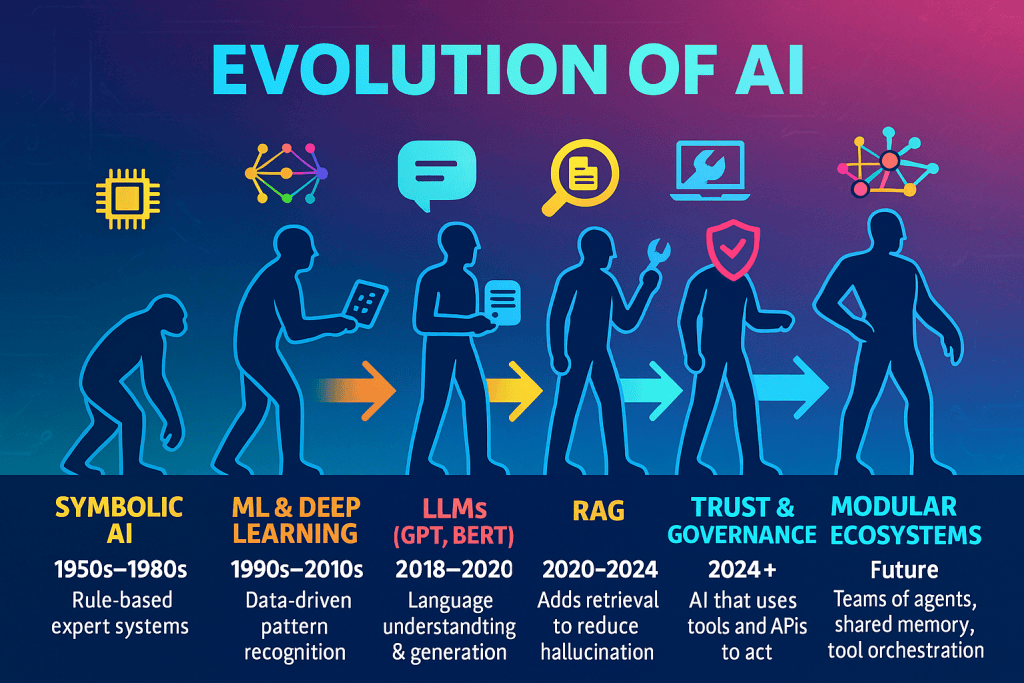
From rule-following logic machines to language wizards, and now to tool-using agents with emerging governance, the story of AI is a story of growing capability, from static to adaptive, from reactive to proactive.
RAG was one of the key chapters in this journey that is part of a much larger arc: AI that doesn’t just know, but can reason, act, and be trusted.
As we look ahead, it’s not just about making smarter models, it’s about building smarter systems, with accountability, collaboration, and real-world utility at their core.
Learn More
- Introducing the Model Context Protocol (MCP) by Anthropic
- Model Context Protocol (MCP) – Anthropic Documentation
- Announcing the Agent-to-Agent Protocol (A2A) by Google
- A2A Protocol – Google GitHub Documentation
- Anthropic’s Model Context Protocol (MCP): A Deep Dive for Developers
- Understanding Google’s A2A Protocol: A New Era of Agent-to-Agent Communication
- Google’s A2A and Anthropic’s MCP Compared
- MCP Safety Audit: Security Exploits in Tool-Augmented LLMs
- Enterprise-Grade Security for MCP: Frameworks and Mitigation Strategies
- Building Secure Agentic Applications Using A2A Protocol
You must be logged in to post a comment.